Designing Depth and Romance: A Guide to the Pink Peony Flower 3D Floral Shadow Box
The intersection of traditional paper crafting and modern digital fabrication has opened new avenues for interior design and personalized gifting. Among the most captivating trends in this space is the creation of layered paper art, specifically designs that utilize depth to mimic natural forms. The Pink Peony Flower 3D Floral Shadow Box stands as a prime example of how digital files can be transformed into tangible, emotive decor. This article explores the artistic principles, technical requirements, and practical applications of creating these multi-layered floral displays, offering insights for hobbyists, professional designers, and educators alike.
The Artistry of Layered Paper Design
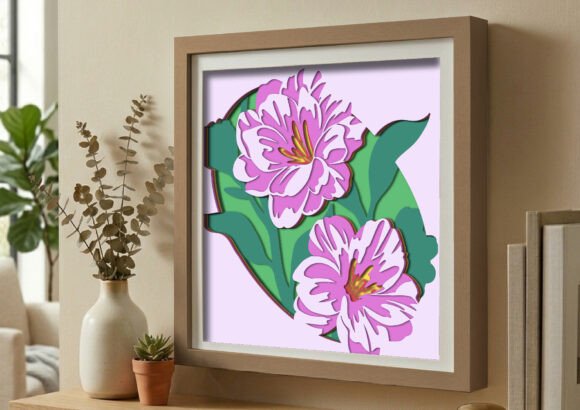
Paper cutting is an ancient art form, but the advent of computer-controlled cutting machines has revolutionized its complexity and accessibility. The core appeal of a 3D shadow box lies in its ability to trick the eye into perceiving volume on a two-dimensional medium. When examining a Pink Peony Flower 3D Floral Shadow Box, one observes not just a flat image, but a sculpture built from successive planes of paper.
The specific design mentioned often features a six-layer structure. This number is not arbitrary; it represents a sweet spot in papercraft engineering. Fewer layers may result in a flat appearance lacking significant depth, while too many layers can make assembly cumbersome and obscure the details of the inner cuts. Six balanced layers allow for a gradual transition from the background to the foreground, creating a "lovely 3D depth" that feels organic rather than mechanical.
In this specific floral arrangement, the aesthetic balance is achieved through color theory and composition. The soft pink tones of the peony petals contrast gently against lush green leaves, all set upon a soft lavender background. This palette is deliberately chosen to evoke romantic elegance and tranquility. For interior designers, understanding this color harmony is crucial. The lavender background serves as a neutral yet warm canvas that allows the pinks to pop without being aggressive, making the piece suitable for spaces dedicated to relaxation, such as bedrooms or nurseries.
Technical Specifications and File Formats
For creators looking to produce a high-quality Pink Peony Flower 3D Floral Shadow Box, the starting point is the digital file. The versatility of modern crafting relies heavily on having access to the correct file formats for various hardware and software ecosystems. A comprehensive package for such a project typically includes a suite of vector and raster files, each serving a distinct purpose in the workflow.
- SVG (Scalable Vector Graphics): This is the industry standard for users of Cricut Explore and Silhouette Designer Edition. SVG files maintain crisp lines regardless of scaling, ensuring that the delicate curves of the peony petals remain smooth whether the project is 6 inches or 24 inches wide.
- DXF (Drawing Exchange Format): Essential for users operating the free version of Silhouette Studio. While less feature-rich than SVG in some contexts, DXF provides the necessary path data for precise cutting without requiring a paid software upgrade.
- EPS and AI Files: Professional graphic designers utilizing Adobe Illustrator or open-source alternatives like Inkscape require these formats. They allow for advanced customization, such as altering the petal shapes, adjusting the spacing between layers, or integrating the floral elements into larger composite designs.
- PNG (Portable Network Graphics): A high-resolution 300dpi file with a transparent background is invaluable for those who may not have cutting machines but wish to print the design for sublimation, digital mockups, or manual tracing.
- PDF Guides: Often overlooked, a comprehensive PDF assembly guide is critical for complex projects. It provides a visual roadmap for layering, ensuring that the creator understands the order of operations to achieve the intended 3D effect.
Optimization for clean and precise cutting is a hallmark of professional-grade files. When a design is described as "expertly crafted," it implies that the vector paths have been welded and simplified to prevent machine hesitation. For laser cutters, this means avoiding unnecessary nodes that could cause burning or jagged edges. For blade cutters, it ensures that intricate details, like the veins in the green leaves or the ruffled edges of the peony, are cut cleanly without tearing the paper.
Material Selection and Assembly Strategies
The transformation from a digital file to a physical Pink Peony Flower 3D Floral Shadow Box depends heavily on material selection. Not all cardstock is created equal. To achieve the desired structural integrity and visual appeal, creators should consider the weight and texture of their paper.
For a project with six layers, using paper that is too thick can result in a bulky final product that may not fit standard shadow box frames. Conversely, paper that is too thin may warp when adhesive is applied or fail to hold its shape against the frame glass. A weight of 65lb to 80lb cardstock is generally recommended. This range offers enough rigidity to maintain the 3D separation between layers while remaining flexible enough for detailed cutting.
Color consistency is another vital consideration. Since the design relies on a gradient of pinks and greens, using cardstock from the same manufacturer and collection ensures uniform hue and finish. Mixing brands can lead to subtle variations in shade that disrupt the visual flow of the blooming peonies.
Assembly requires patience and precision. The process typically involves working from the background layer forward. Adhesive choice is paramount; foam tape or silicone adhesive dots are preferred over liquid glue. These spacers create the physical distance between layers that generates the shadow effect. Applying adhesive only at strategic points—such as the center of the flower or the base of the leaves—prevents the paper from buckling and maintains the airy, floating appearance of the petals.
Diverse Applications and Use Cases
The utility of the Pink Peony Flower 3D Floral Shadow Box extends far beyond simple wall decoration. Its versatile aesthetic makes it a powerful tool for various sectors, including event planning, education, and commercial retail.
Residential Interior Decor
In the home, this design serves as a focal point that adds sophistication without overwhelming the space. The soft pink and lavender palette is particularly effective in bedrooms and nurseries, where calming visuals are desired. Unlike mass-produced prints, a hand-assembled shadow box carries a texture and depth that interacts with natural light throughout the day, casting subtle shadows that change the room's ambiance.
Gifting and Milestones
As a handmade gift, the effort invested in assembling a multi-layered paper flower conveys a deep sense of care. It is an ideal choice for Mother's Day, anniversaries, or birthdays. The symbolism of the peony—often associated with romance, prosperity, and honor—adds emotional weight to the gift. For small business owners selling handmade goods, offering a kit version of this design allows customers to participate in the creative process, adding value to the product.
Educational Workshops
Educators and workshop leaders can utilize this design to teach principles of geometry, layering, and color theory. The six-layer structure provides a clear example of how repetition and slight variation in shape create form. It is an excellent project for teaching students about vector design, as they can manipulate the AI or EPS files to understand how digital paths translate to physical cuts.
Workflow Optimization for Creators
For professionals running a crafting business, efficiency is key. When producing multiple units of a Pink Peony Flower 3D Floral Shadow Box, optimizing the cutting workflow can significantly reduce production time. This begins with "nesting" the design pieces on the digital mat to minimize waste. Most cutting software allows users to arrange the SVG components tightly, maximizing the use of each sheet of cardstock.
Batch processing is another effective strategy. Cutting all background layers for ten boxes at once, followed by all mid-layers, and finally the foreground details, streamlines the assembly line. This method reduces the need to constantly change mats or reload materials. Furthermore, pre-cutting adhesive spacers to uniform sizes before beginning assembly ensures consistency across all finished products.
Quality control is the final step in the workflow. Each layer should be inspected for incomplete cuts or "weeding" errors (where small pieces of paper fail to detach). A magnifying lamp can be helpful here to ensure that the delicate connections in the petal designs are intact. A single torn petal can detract from the overall elegance of the piece, so meticulous inspection is non-negotiable for professional results.
The Role of Lighting and Framing
The final presentation of the Pink Peony Flower 3D Floral Shadow Box is heavily influenced by lighting and framing choices. A deep-set shadow box frame is required to accommodate the six layers of paper plus the adhesive spacers. Standard photo frames will crush the design, destroying the 3D effect.
Lighting plays a dramatic role in enhancing the depth. Directional lighting, such as a picture light mounted above the frame or a nearby lamp, casts shadows from the upper layers onto the ones below. This interplay of light and shadow accentuates the contours of the peony petals, making them appear to bloom outward from the wall. In contrast, flat, ambient lighting may diminish the perception of depth. Therefore, when advising clients or planning installation, considering the light source is as important as the design itself.
In conclusion, the Pink Peony Flower 3D Floral Shadow Box represents a harmonious blend of digital precision and analog craftsmanship. Whether utilized for personal home decor, educational purposes, or commercial product lines, its six-layer design offers a robust platform for creativity. By understanding the technical nuances of file formats, material properties, and assembly techniques, creators can consistently produce high-quality pieces that capture the delicate charm of nature in a lasting, three-dimensional form.