Mastering the Play Mode Greeting Card: A Guide to Layered Gaming SVG Design
In the evolving landscape of digital crafting, few trends have captured the imagination of hobbyists and professional designers quite like the layered paper greeting card. Specifically, the "Play Mode" concept—a unique handcrafted style featuring a striking game controller design—represents a perfect fusion of nostalgia, modern technology, and tactile artistry. This article serves as a comprehensive guide to understanding what makes these cards special, how the underlying Gaming SVG files function, and why this specific design stands out as both a memorable communication tool and a standalone display piece.
The Evolution of the Greeting Card in the Digital Age
For decades, the greeting card industry was dominated by flat, mass-produced paper goods. While charming, they often lacked the depth and personalization that modern crafters seek. The introduction of SVG (Scalable Vector Graphics) files revolutionized this space. Unlike traditional raster images (like JPEGs) that lose quality when enlarged, SVGs are mathematical paths that can be scaled infinitely without pixelation. This technology allows cutting machines to precisely slice intricate patterns into various weights of paper, enabling the creation of complex, multi-layered structures.
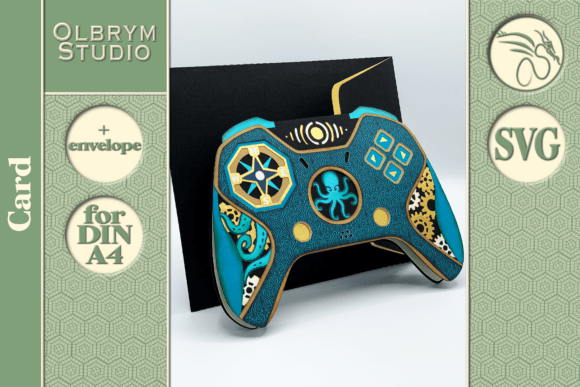
The "Play Mode" card is a prime example of this evolution. It moves beyond a simple folded sheet of paper to become a dimensional art object. By utilizing layered elements, vibrant teal and gold accents, and intricate decorative patterns, the card transforms a standard message into an experience. It appeals not just to gamers, but to anyone who appreciates the intersection of mechanical details and artistic flair.
Deconstructing the "Play Mode" Aesthetic
What exactly defines the visual language of this specific card? The design is built on a foundation of contrast and thematic cohesion. At its heart lies the game controller motif, a universal symbol of interaction and play. However, the design elevates this common icon by surrounding it with unexpected elements:
- Nautical and Mechanical Fusion: The inclusion of a compass and an octopus motif adds a sense of adventure and exploration. This suggests that gaming is not just a sedentary activity, but a journey into new worlds.
- Color Psychology: The use of vibrant teal paired with gold accents creates a bold, luxurious look. Teal often represents clarity and emotional balance, while gold signifies value and celebration.
- Dimensional Depth: Perhaps the most critical feature is the card's ability to stand upright when opened. This is achieved through strategic layering, where different pieces of paper are stacked using adhesive spacers or folded tabs to create shadows and depth.
This combination ensures the card is not merely read and discarded; it becomes a display piece. For gamers and lovers of creative design, having a card that looks like a miniature sculpture adds significant personality to any celebration, whether it be a birthday, a holiday, or a "just because" gesture.
Technical Specifications and Material Requirements
Creating a high-quality layered card requires more than just a good design file; it demands an understanding of materials. The "Play Mode" project is optimized for DIN A4 dimensions, a standard size widely used in Europe and increasingly popular globally for its efficiency. Understanding the specific measurements and material weights is crucial for success.
Understanding Dimensions
The project is meticulously calculated to fit within standard constraints while maximizing visual impact:
- Card Dimensions: When assembled, the card measures approximately 13.2 cm (5.2 inches) in height and 18.3 cm (7.2 inches) in width. This landscape orientation provides ample space for the wide controller design and allows the card to sit stably on a shelf or desk.
- Envelope Dimensions: To accommodate the added bulk of the layered elements, the envelope is sized at 19.1 cm (7.5 inches) in height and 15.6 cm (6.1 inches) in width. This extra room is vital to prevent crushing the delicate 3D elements during mailing.
The Importance of Paper Weight (GSM)
A common misunderstanding among beginners is that all cardstock is the same. In layered projects, the weight of the paper, measured in grams per square meter (gsm), dictates the structural integrity of the final product. The supply list for this project specifies three distinct weights:
- 130gsm Paper: This lighter weight is ideal for the topmost decorative layers or intricate cut-outs like the octopus tentacles or fine mechanical details. It cuts cleanly and bends easily without cracking.
- 160gsm Paper: Serving as the mid-weight option, this is perfect for the main body of the controller or the background layers that need to hold their shape but still allow for some flexibility.
- 300gsm Paper (Optional): This heavy-duty cardstock is essential for the base of the card. It provides the rigidity needed for the card to stand upright without flopping over. Using 300gsm for the foundation ensures the dimensional look remains bold and stable.
The Assembly Process: From Digital File to Physical Art
One of the most empowering aspects of this project is that it is a digital product for instant download. No physical product is sent; instead, the creator receives the tools to build the item themselves. This shift empowers users to customize colors, textures, and messages, making each card unique.
Files and Tools Included
Upon purchase, the user typically receives a PDF manual and folders containing the SVG files. The PDF Manual acts as a visual roadmap, guiding the crafter through the layering order. The SVG files are compatible with major cutting machines (such as Cricut or Silhouette), which automate the cutting process with precision.
To assemble the "Play Mode" card, the following supplies are generally required:
- Adhesives: Standard glue is used for flat layers, but Velcro glue dots (specifically 1.5 cm) are often recommended for creating the 3D lift between layers. These dots act as spacers, casting shadows that enhance the dimensional effect.
- Ink (Optional): While the colored paper provides the base hue, adding ink to the edges (distressing) can deepen the shadows and make the mechanical details pop even more.
Step-by-Step Logic
The assembly follows a logical progression from back to front. First, the 300gsm base is prepared. Next, the background layers featuring the compass and decorative patterns are adhered. The game controller is then built up layer by layer, using the glue dots to elevate the buttons and joysticks. Finally, the octopus motif and gold accents are applied to complete the scene. Inside the card, there is dedicated space for a heartfelt message, ensuring that despite the elaborate exterior, the primary purpose of communication remains central.
Why This Matters: Creativity, Business, and Connection
The rise of projects like the "Play Mode" greeting card reflects broader shifts in how we approach creativity and commerce. For the home crafter, it offers a manageable yet impressive project that builds skills in layering, color theory, and structural engineering. It demystifies the process of making professional-looking goods.
For small business owners and Etsy sellers, these SVG files represent a scalable business model. Since the product is digital, there are no inventory costs or shipping logistics for the seller. They can sell the same file thousands of times, providing value to customers who want to create personalized gifts without designing from scratch. This fits perfectly into the modern "gig economy" and the maker movement.
Furthermore, in an era of digital communication where texts and emails are fleeting, a handcrafted, dimensional card carries significant emotional weight. It signals effort, thoughtfulness, and a deep understanding of the recipient's interests—in this case, a love for gaming and adventure. It bridges the gap between virtual hobbies and physical reality.
Conclusion
The "Play Mode" greeting card is more than just a collection of paper and glue; it is a testament to the power of Gaming SVG technology and human creativity. By combining a striking game controller design with nautical motifs, vibrant teal and gold accents, and precise engineering, it creates a bold dimensional look that stands the test of time. Whether you are a beginner looking to try your first layered project or an experienced designer seeking to expand your portfolio, understanding the mechanics behind these cards—from GSM weights to envelope sizing—is key to success.
As you embark on creating this piece, remember that the true value lies not just in the final product, but in the process of bringing a digital file to life. It is a celebration of adventure, personality, and artistic flair, offering a special way to present a heartfelt message that truly stands out in a world of flat screens.